
DeepFilterNet: The Real-Time Speech Enhancement AI Behind Noise Reducer
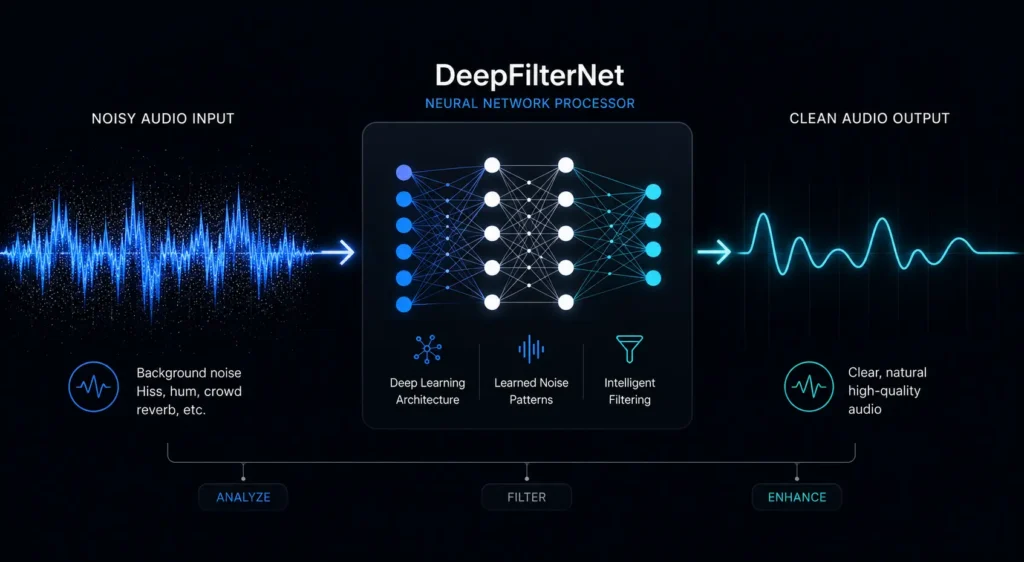
DeepFilterNet is a two-stage deep learning framework built specifically for real-time speech enhancement. It’s the AI engine running inside tools like Noise Reducer AI — and if you’ve ever wondered why some noise reduction sounds natural while others leave behind that warbling, metallic ghost called “musical noise,” the answer lives inside this architecture. Developed by researchers at RWTH Aachen University and first published in 2021, DeepFilterNet has become one of the most widely adopted open-source noise suppression frameworks precisely because it accomplishes something most models fail at: it runs fast enough for live audio on a single CPU thread, without sounding like it’s destroying the voice to save the signal.
This isn’t another rehash of “AI removes background noise from your calls.” This is a technical deep-dive into what makes DeepFilterNet different, how its two-stage pipeline operates, and why practitioners choose it over alternatives like RNNoise or NVIDIA RTX Voice for certain use cases.
Why Traditional Noise Reduction Fails (and Where DeepFilterNet Starts)
Before getting into the architecture, you need to understand what DeepFilterNet was designed to fix.
Classic approaches — spectral subtraction, Wiener filtering, spectral gating — all operate on the same flawed assumption: noise is stationary. Estimate the noise floor during a pause in speech, subtract it from the full signal, done. It works fine for HVAC hum in a recording studio. It completely falls apart when your noise source is a barking dog, a coffee grinder that cycles on and off, or a crowded café where the ambient sound shifts every few seconds.
These are called non-stationary noise sources, and they break static noise floor estimators because there’s no stable baseline to subtract. The result is that warbling artifact — musical noise — where the algorithm is essentially chasing a moving target and leaving residual tones wherever it overshoots.
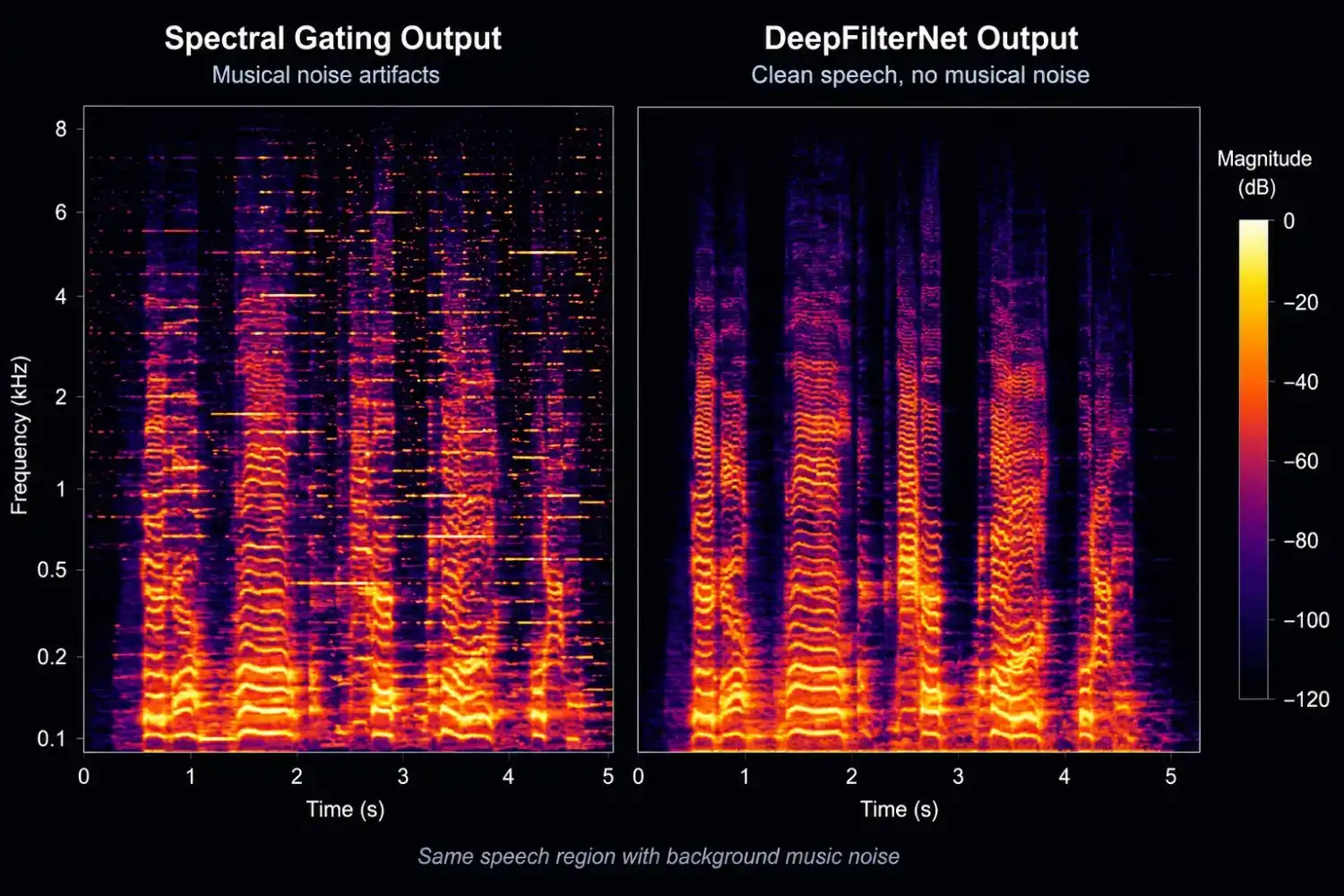
Standard deep learning approaches using complex ratio masks (CRM) improved matters significantly. Instead of subtracting a noise estimate, a neural network learns to predict a mask — a per-frequency-bin multiplier that suppresses noise while preserving speech. But CRMs have their own ceiling: they treat each time-frequency bin as independent. They perform a pointwise multiplication in the STFT domain, which means they can’t exploit temporal correlation between adjacent frames. At coarse frequency resolutions — which you need to stay below 20 ms latency — harmonics blend into adjacent bins and masks can’t resolve them cleanly.
DeepFilterNet’s core insight is to replace the pointwise mask multiplication with a learned short FIR filter across time at each frequency bin. This is the “deep filtering” in the name, and it’s the architectural innovation that makes the whole framework work.
The Two-Stage Architecture: What Actually Happens to Your Audio
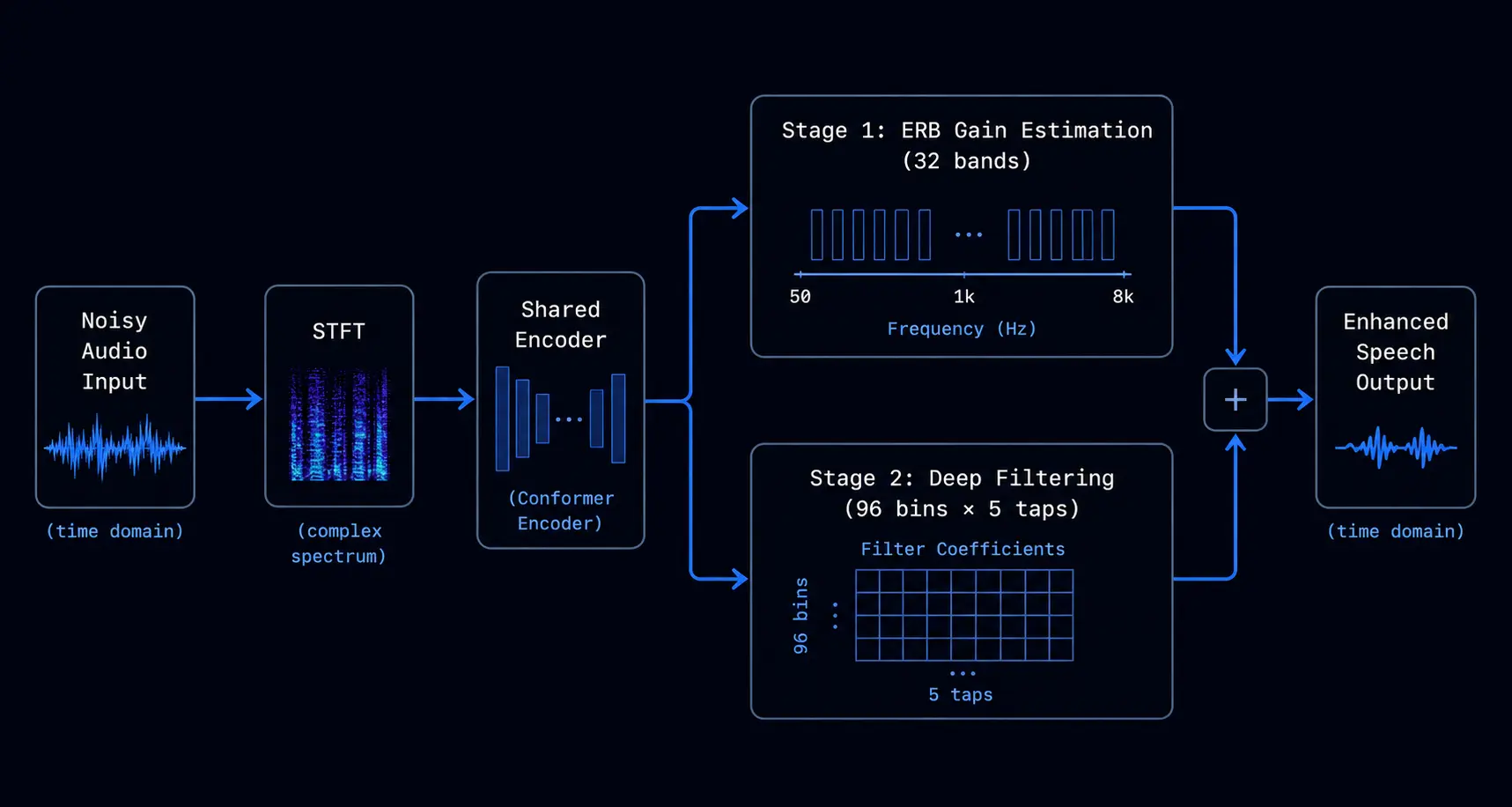
DeepFilterNet is a two-stage speech enhancement framework that integrates multi-frame complex filtering with ERB gain estimation to deliver real-time, low-latency performance. Understanding why it’s two stages — and what each stage does — is where the real insight lies.
Stage 1: Spectral Envelope Enhancement in the ERB Domain
The first stage operates in the Equivalent Rectangular Bandwidth (ERB) domain, not directly in the raw STFT. ERB is a psychoacoustic frequency scale — it compresses the frequency axis in a way that mimics how the human auditory system perceives pitch. At low frequencies, we resolve small differences. At high frequencies, we lump wider bands together as perceptually similar. Using the ERB scale reduces the dimensionality of the problem significantly.
The first stage enhances the spectral envelope using ERB-scaled gains that model human frequency perception. The network predicts 32 coarse gain values across these ERB bands. Think of this as the rough pass — it handles broadband noise suppression and gets the overall energy distribution of the signal closer to clean speech. The ERB compression means you’re doing meaningful perceptual work with a fraction of the computational cost you’d spend working in full STFT resolution.
The system achieves a real-time factor (RTF) of 0.19 on a single-threaded Intel i5-8250U CPU — meaning it processes audio roughly five times faster than real-time on modest consumer hardware without any model quantization or pruning. That figure isn’t theoretical; it’s what makes DeepFilterNet viable on hearing aids and embedded devices.
Stage 2: Deep Filtering for Periodic Structure Recovery
The second stage is where DeepFilterNet earns its name. DeepFilterNet generalizes masking by introducing deep filtering — a learned short FIR filter across time at each frequency bin. This enables reconstruction of degraded harmonics and local temporal correlations vital for intelligibility and perceptual quality.
In practical terms: speech is periodic. Vowel sounds, voiced consonants — these have harmonic structure. Standard masks either preserve or suppress each time-frequency bin, but they can’t reconstruct a harmonic that got partially masked by noise unless they look at neighboring frames. The learned FIR filters in Stage 2 do exactly that. They apply a multi-frame complex filter that exploits inter-frame correlation, recovering the fine temporal structure of speech that Stage 1’s coarser processing doesn’t address.
The architecture restricts deep filtering to 96 bins × 5 taps (480 complex outputs), supplemented with 32 envelope gains. The 5-tap filter means the network looks across five frames to decide what each bin’s enhanced value should be. Enough context to reconstruct harmonics; tight enough to maintain low latency.
The Encoder-Decoder Backbone
Both stages share an encoder that extracts features from the noisy input’s ERB and complex representations simultaneously. The encoder uses separable convolutions and grouped linear layers — architectural tricks that reduce parameter count and computation. The decoders for each stage are separate but share this encoded representation.
An SNR-gated decoding mechanism uses a learned SNR estimate to disable decoders in extreme noise conditions. This is a practical detail that matters: when the signal-to-noise ratio is catastrophically low, the model doesn’t thrash trying to recover speech that isn’t there. It gracefully attenuates rather than hallucinating harmonics.
DeepFilterNet vs. DeepFilterNet2 vs. DeepFilterNet3: What Changed
DeepFilterNet (2021)
The original, published at ICASSP 2022. Established the two-stage ERB + deep filtering paradigm. Ran on 48 kHz audio. Demonstrated state-of-the-art PESQ and SI-SDR scores at a fraction of the compute cost of contemporaries like DCCRN or FullSubNet. The paper showed deep filtering outperformed complex ratio masks across a variety of frequency resolutions — a critical result because it meant the approach worked even with the short FFT windows needed for low-latency deployment.
DeepFilterNet2 (2022)
DeepFilterNet2 comprises one encoder and two decoders containing mainly convolutional layers, grouped linear layers and gated recurrent units, adding up to 2.31M parameters. The focus for version 2 was pushing toward embedded deployment — hearing aids, mobile devices, microcontrollers. Architectural refinements reduced complexity further while maintaining quality. This is the version that ships as the default in the open-source deep-filter CLI tool on GitHub.
The key lesson from DeepFilterNet2 for practitioners: the grouped linear and recurrent layers are where most of the memory bandwidth goes. On systems with shared CPU/memory architectures — like ARM SoCs — this matters more than raw parameter count.
DeepFilterNet3 (2025–2026)
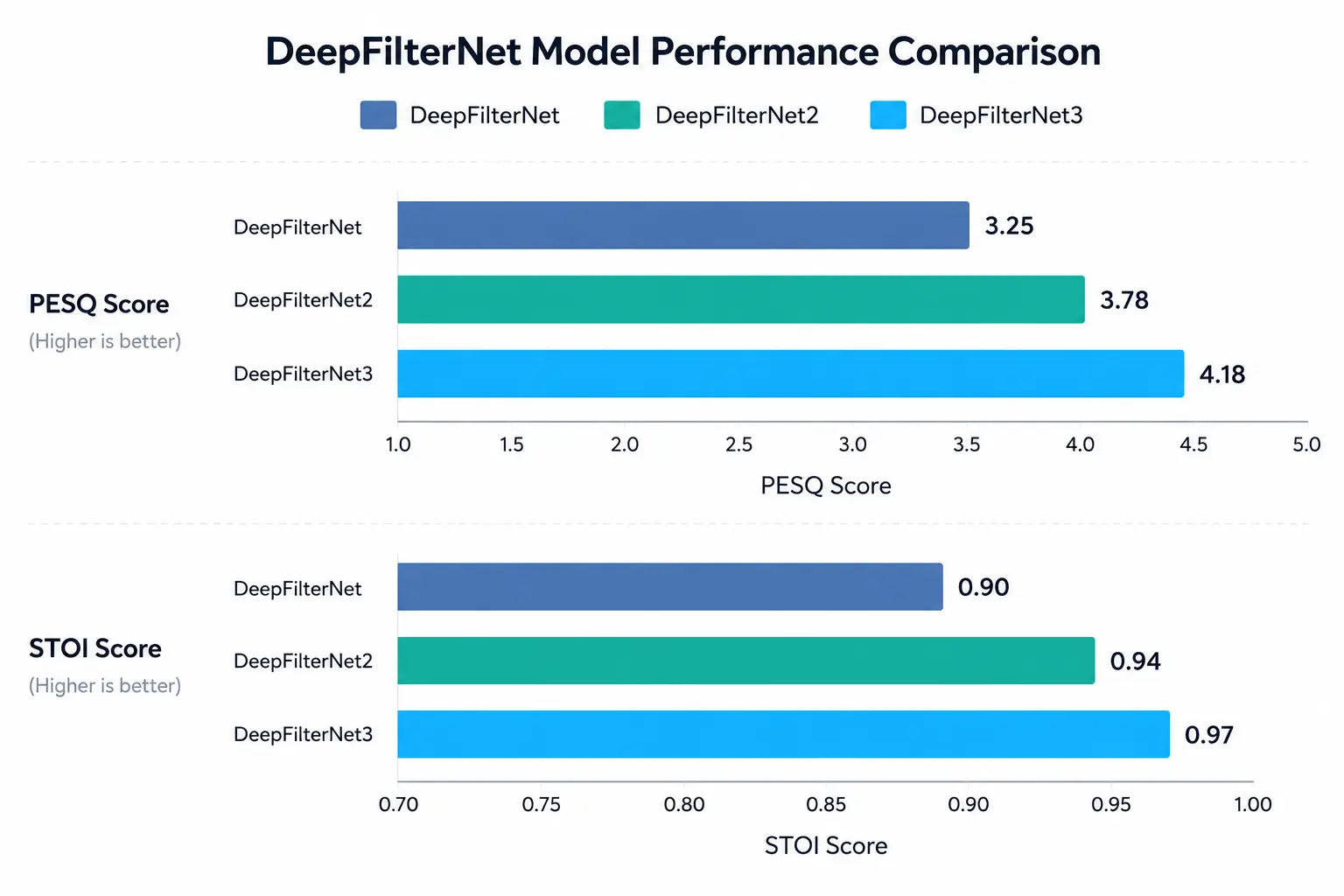
DeepFilterNet3, with major updates in 2025 and early 2026, represents the current state of the art. It incorporates additional network layers, larger and more diverse training datasets, and refined perceptual optimization. The result is superior handling of complex noise sources, including synthetic AI-generated voices, dense urban environments, and overlapping speech.
Latency remains in the 10–20 ms range, while perceptual quality scores improve to PESQ 3.5–4.0+ and STOI exceeding 0.95.
PESQ (Perceptual Evaluation of Speech Quality) and STOI (Short-Time Objective Intelligibility) are the two metrics that actually matter in this space. PESQ scores range from −0.5 to 4.5; a raw, noisy signal might score 1.5–2.0 in challenging conditions, and anything above 3.5 is considered high-fidelity to listeners in controlled tests. STOI above 0.95 means the enhanced speech is highly intelligible — listeners can understand more than 95% of words in standardized intelligibility tests. These aren’t marketing numbers; they’re the benchmarks the DNS Challenge (Microsoft’s Deep Noise Suppression benchmark) uses to compare systems.
How Noise Reducer AI Uses DeepFilterNet
The architecture of Noise Reducer AI is centered around the DeepFilterNet framework. Unlike traditional Digital Signal Processing (DSP) methods such as spectral gating or basic subtraction — which often introduce audible artifacts and “musical noise” — the engine operates in the STFT domain to perform precise vocal isolation. By mapping a perceptual loss function across the frequency spectrum, the AI effectively distinguishes between non-stationary background noise and the primary speech signal.
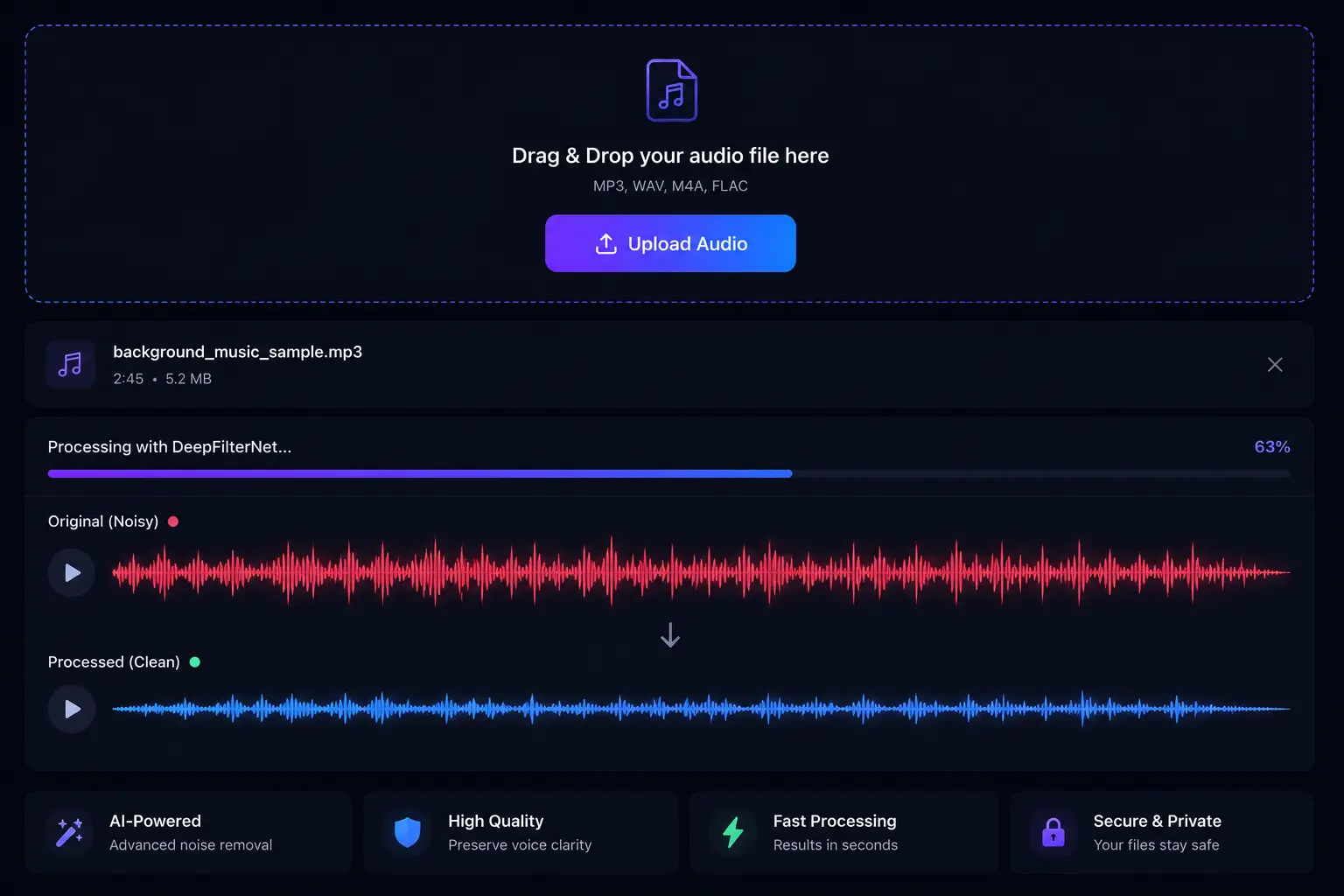
The practical advantage for post-production use cases — podcasters, video editors, voice-over artists — is that Noise Reducer AI provides DeepFilterNet’s capabilities without requiring local setup. Running DeepFilterNet locally means managing a Rust-based CLI or Python bindings, ensuring your audio is 48 kHz mono, and dealing with the lookahead delay compensation if you need sample-accurate processing. A web-based wrapper handles all of that, at the cost of uploading your audio to a server.
Even when processing high-bitrate WAV or MP3 files, the output maintains its original harmonic integrity and 48 kHz high-fidelity resolution. The 48 kHz requirement isn’t arbitrary — it preserves the full frequency range of speech including the high-frequency consonants (fricatives like /s/, /f/, /sh/) that give speech its clarity. Many older models worked at 16 kHz, which sounds fine on a phone call but loses presence in podcast-quality audio.
Common Practitioner Mistakes When Using DeepFilterNet
These aren’t beginner errors. These are the things experienced audio engineers get wrong when they first adopt DeepFilterNet.
Ignoring minimum audio duration. One frequent mistake is ignoring the DeepFilterNet minimum audio duration for effective denoising. Clips shorter than 80–100 ms often produce incomplete suppression or edge artifacts. Always pad short segments with silence if needed. This bites developers building voice activity detection pipelines who pass individual word segments rather than continuous utterances.
Not compensating for STFT lookahead delay. DeepFilterNet introduces a small processing delay — typically one frame of lookahead plus the STFT window length. In real-time systems, this is fine. In post-production systems where you’re aligning enhanced audio with video or other tracks, the --compensate-delay flag in the CLI matters. Miss it, and your audio drifts out of sync by 10–20 ms — subtle enough to not notice immediately, obvious enough to ruin professional output.
Applying it to already-processed audio. Running DeepFilterNet on audio that’s already been through a compressor, limiter, or another noise reduction pass can backfire. The model was trained on raw noisy speech. Heavy compression changes the statistical properties of the noise floor in ways the model wasn’t trained to handle, sometimes producing over-suppression artifacts on transients.
Expecting it to handle music. DeepFilterNet is a speech enhancement model, full stop. It was trained to preserve speech harmonics. Feed it music, and it will try to protect vocal frequencies while attenuating instrumental content — often dramatically. If your use case involves music, you need a different model.
Over-relying on default attenuation settings. Another common error is over-relying on default settings without testing. The attenuation limit controls how aggressively the model suppresses noise. Higher attenuation sounds cleaner in quiet passages but introduces more processing artifacts on rapid noise transients. The right setting depends on your noise environment — and the defaults are tuned for a broad middle ground, not your specific recording conditions.
DeepFilterNet vs. Competing Approaches
vs. RNNoise
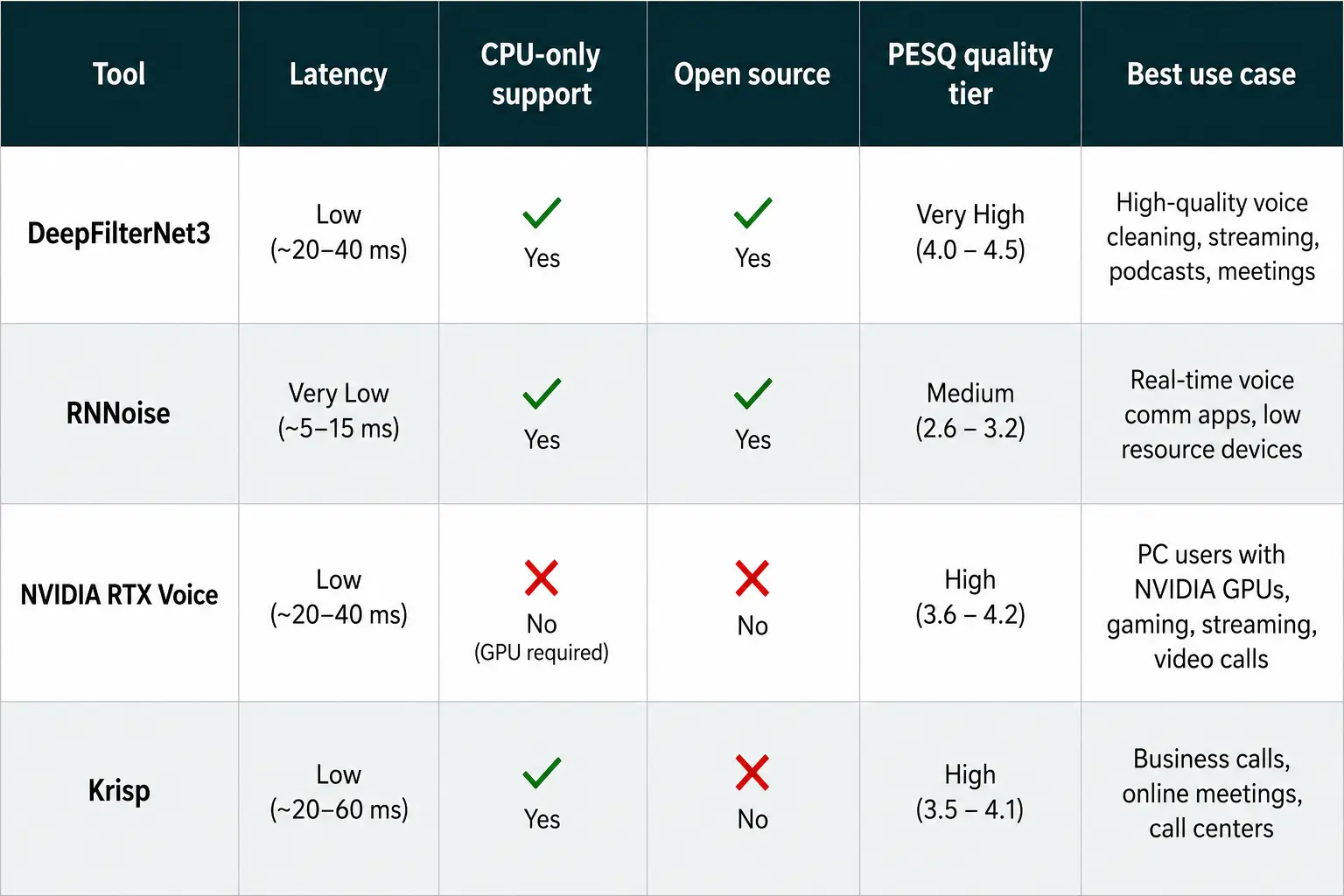
RNNoise, developed at Mozilla and Xiph, uses a GRU-based recurrent network trained on a relatively small feature set. It’s even lighter than DeepFilterNet — designed originally for WebRTC integration. In controlled tests, DeepFilterNet stands out as one of the most capable open-source AI noise reduction solutions compared to RNNoise, particularly for non-stationary noise and for preserving high-frequency speech content above 8 kHz. RNNoise processes at 48 kHz but its effective bandwidth was originally designed around 8 kHz perceptual models. It’s still excellent for WebRTC voice calls; it’s not the right tool for podcast post-production.
vs. NVIDIA RTX Voice / Broadcast
RTX Voice (now NVIDIA Broadcast) runs a significantly larger neural network on NVIDIA GPU hardware. Quality ceiling is higher; latency can be lower with a fast GPU. But it requires an NVIDIA GPU with RTX hardware, consumes 1–3 GB of VRAM, and introduces significant driver and platform complexity. DeepFilterNet runs on any CPU. For podcast post-production without an NVIDIA GPU, there’s no real comparison.
vs. Krisp / NVIDIA Maxine Cloud
These are commercial products that run noise suppression in the cloud or with proprietary on-device models. Quality is generally excellent. But they come with per-minute pricing at scale, data privacy considerations (your audio leaves your device), and vendor lock-in. DeepFilterNet is MIT-licensed open source — you can run it on-premise, embed it in products, and modify it freely.
Technical Deployment: Running DeepFilterNet Locally
For developers who want to run DeepFilterNet directly rather than through a web service:
The canonical reference implementation lives at github.com/Rikorose/DeepFilterNet. It includes a LADSPA plugin with PipeWire filter-chain integration for real-time noise reduction on your microphone. The CLI tool deep-filter processes WAV files at 48 kHz. For Python integration, the deepfilternet PyPI package exposes the model directly.
Key configuration points:
- Sample rate: 48 kHz only for the reference models. Resampling to 48 kHz before processing and back to your target sample rate after is the correct approach, not running at 16 or 44.1 kHz natively.
- Look-ahead: The
--compensate-delayflag in the CLI adds the lookahead compensation. For streaming applications, account for this in your buffer management. - Model selection: DeepFilterNet2 is the default binary. DeepFilterNet3 requires specifying the model path explicitly with
-m. - Real-time factor: On a modern i5 or i7 CPU, expect RTF well below 0.5 for DeepFilterNet2. DeepFilterNet3 is slightly heavier but still well within real-time on any post-2018 desktop processor.
DeepFilterNet3 combines three attributes that are particularly attractive for product teams and platform owners: an open model and reference implementation, enabling rapid experimentation and integration without restrictive licensing. The Apache 2.0 and MIT licensing on the models means commercial use is straightforward.
The Training Data Question
Model performance is only as good as what it was trained on. DeepFilterNet’s training protocol leverages multi-lingual and high-quality corpora with domain-matched losses, including the DNS4 corpus with heavy oversampling of PTDB and VCTK speakers.
The DNS (Deep Noise Suppression) corpus from Microsoft is the benchmark dataset in this field — it contains thousands of hours of clean speech mixed with noise recordings from real-world environments. VCTK is a multi-speaker dataset covering diverse accents from British English. PTDB (Pitch-Tracking Database) provides phonetically rich speech with pitch ground truth. This combination matters because accent diversity in training directly affects how well the model preserves speech from non-American-English speakers — a practical concern for global deployments.
DeepFilterNet3’s improvements in robustness to “synthetic AI-generated voices” are noteworthy. As TTS systems become more prevalent in call centers and voice interfaces, noise suppression models need to handle synthetic speech — which has different statistical properties than human speech — without treating it as noise.
Noise Reducer AI is an AI-powered audio enhancement platform designed to remove background noise, improve voice clarity, and enhance sound quality. Built for creators, professionals, and everyday users, it offers a fast, free, and easy way to clean audio without technical complexity.
FAQ: DeepFilterNet and Noise Reducer AI
Check out these frequently asked questions to find quick answers and helpful tips!